American Bresse vs. Orpington vs. Cornish Cross: Which Meat Chicken Is Best?
How Genetics, Growth, and Age Change Chicken Meat
A customer recently asked me how the meat from my standard-bred Orpingtons compares with American Bresse and Cornish Cross chickens.
The short answer is that they are all chickens—but they were developed for very different jobs.
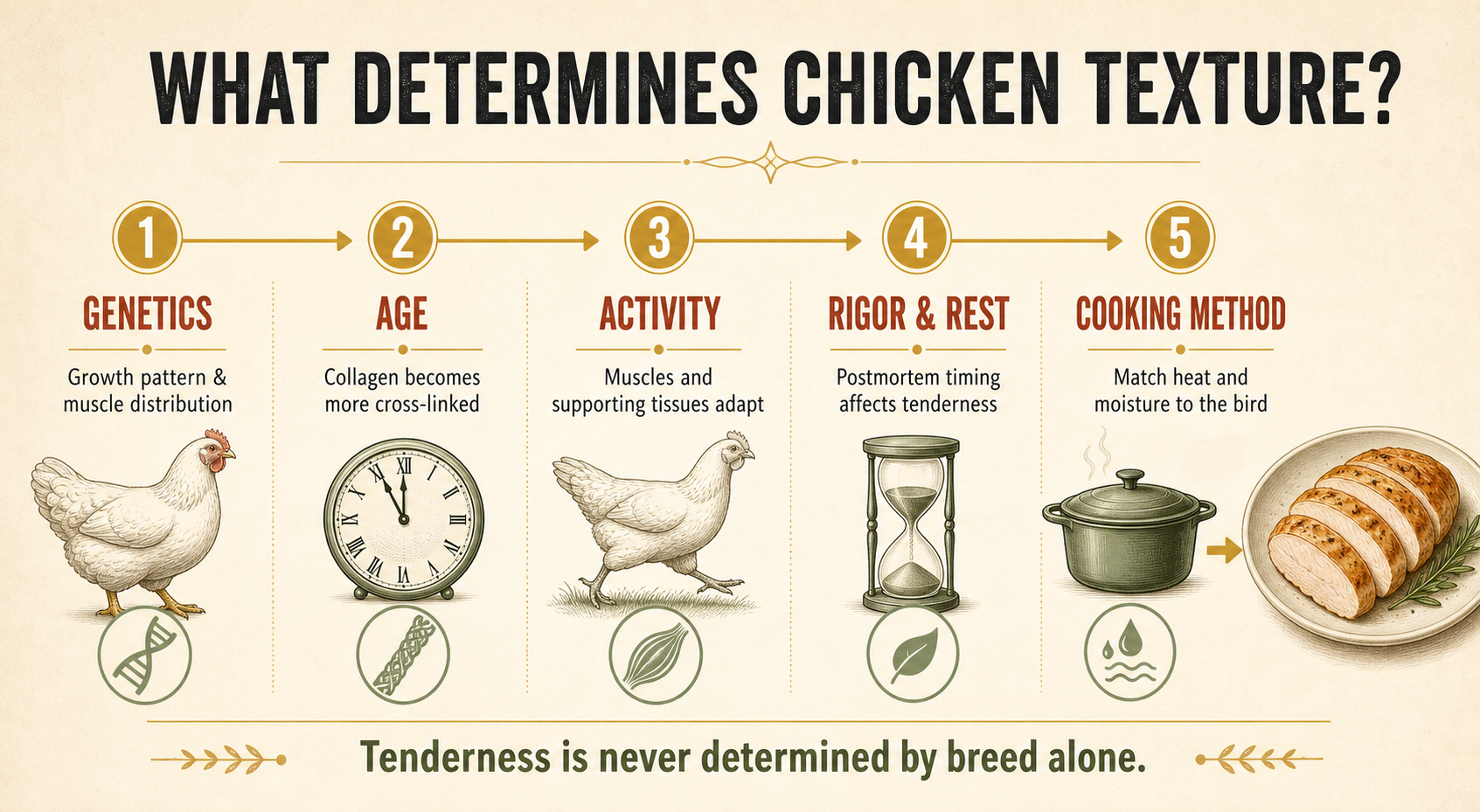
Genetics influence how quickly a bird grows, where it places muscle, when it reaches maturity, and how efficiently it converts feed into body weight. Age and activity change the muscle and connective tissue. Processing, resting, and cooking methods then determine whether that meat reaches the table tender or tough.
That means the breed is only part of the answer.
Quick Look
Cornish Cross chickens are selected for extremely rapid growth, feed efficiency, and a consistent commercial carcass.
American Bresse can offer a balance between meat production, egg production, and the ability to reproduce on the farm.
Standard-bred Orpingtons grow slowly, mature later, and may produce darker, firmer meat with excellent flavor.
Older and more active birds generally develop more mature connective tissue.
Cooking freshly processed poultry during rigor mortis can make any breed seem unnecessarily tough.
The best chicken depends on whether your priority is speed, self-sufficiency, breeding, flavor, or cooking versatility.
Selection Builds Different Chickens
A chicken’s body is not simply a product of how much it eats. It is also the result of generations of selection.
Commercial Cornish Cross chickens have been intensely selected for rapid growth, feed conversion, breast-muscle yield, and predictable carcasses. Standard-bred Orpingtons have historically been selected for breed type, size, shape, feather color, and exhibition qualities. American Bresse breeders may select for meat shape, growth, egg production, fertility, temperament, or a combination of those traits.
Selection is cumulative. When breeders consistently choose birds with particular characteristics, the frequency of the genes contributing to those characteristics can increase within the population.
This does not mean that selecting one trait automatically destroys another. It does mean that traits that are not measured and intentionally maintained can change over generations.
That is why reproduction and selection are not the same thing. Producing chicks creates another generation. Selection determines which birds are allowed to shape it. I discussed that distinction more fully in Pullet Eggs, Hen Eggs, and the Difference Between Reproduction and Selection.
Growth Rate Is More Than Final Weight
Two chickens can eventually reach a similar weight without developing in the same way or on the same schedule.
Rapid-growing commercial broilers place muscle at an extraordinary rate. Research on modern broilers shows that this rapid muscle growth can outpace the development or functional capacity of the skeletal, cardiovascular, and respiratory systems. It is one reason fast-growing broilers require careful management and can be more susceptible to leg problems, metabolic stress, and breast-muscle disorders. A recent scientific review summarizes these growth-related concerns.
That does not make Cornish Cross chickens inherently “bad.” Their rapid, efficient growth is exactly what they were developed to do. It simply means their biology and management requirements differ from those of a slower-growing chicken. For a broader look at how breeding changed the chickens on our tables, read Heritage Chickens, Modern Broilers, and the Lost Middle Ground of Poultry Flavor.
My standard-bred Orpingtons develop very differently. In my flock, they appear to spend a long time building frame before filling that frame with muscle. They mature slowly and can become exceptionally large, but they require considerably more time and feed to get there.
My American Bresse fall between those extremes. I evaluate them around 17 to 18 weeks for the body shape I want on the table and in future generations: a deep, wide, long body, broad shoulders, and a low tail.
My best-shaped birds become breeders. The others go to the freezer.
That selection process is important because American Bresse are not as commercially uniform as Cornish Cross chickens. Individual lines may vary considerably. If breeders do not keep selecting for productive body shape, growth, fertility, and egg production, the birds may eventually become very different from the flock they started with.
You can read more about the goals of my own American Bresse breeding program.
Activity Changes Muscle, Tendons, and Connective Tissue
A bird that walks, scratches, flies onto roosts, and ranges over a large area is repeatedly loading its muscles, bones, tendons, and ligaments.
Those tissues respond to use.
Studies in chickens have found that physical activity can increase tendon collagen content and improve tendon strength and mechanical properties. This supports the common observation that an active, slower-growing chicken does not develop exactly like a young broiler raised primarily for rapid weight gain. Research on chicken tendons demonstrates this response to activity.
The important correction is that Cornish Cross chickens still have tendons and ligaments, and they absolutely develop those tissues. The difference is the relationship among activity, growth rate, age, body weight, and tissue development.
A slower-growing chicken simply has more time—and often more opportunity for movement—for those tissues to adapt.
That difference can also influence the texture of the meat. More developed connective tissue can make meat firmer, particularly in the legs and other heavily used muscles.
Why Older Chicken Is Usually Firmer
Age has a major influence on poultry-meat tenderness.
Collagen is the primary structural protein in connective tissue. As an animal matures, collagen develops more stable cross-links. Those cross-links make the connective tissue stronger and less easily broken down by quick, dry cooking.
Research in chickens has found a strong relationship between age-related collagen cross-linking and increased meat toughness. This is especially apparent when comparing younger birds with mature hens.
This is why an older Orpington rooster should not be cooked like a young Cornish Cross broiler.
The older bird is not necessarily poor-quality meat. It is a different kind of meat.
In my experience, mature Orpington meat is darker, firmer, and richer in flavor. It is excellent for:
Soup
Stock
Chicken and dumplings
Pressure cooking
Braising
Slow roasting
Shredded chicken dishes
Trying to grill the breast quickly and expecting supermarket-broiler tenderness would be using the wrong cooking method for the biology of the bird.
Rigor Mortis: The Step That Can Make Any Chicken Tough
Breed and age are not the only reasons home-raised chicken may be tough. Sometimes the bird is cooked too soon after processing.
After death, the muscles no longer receive oxygen, but they briefly continue using stored energy. As that energy supply is depleted, the muscle proteins actin and myosin become locked together. The muscles stiffen in a process called rigor mortis.
Cooking the chicken during this stiffened period can produce meat that is remarkably tough—even when the bird is young.
Rigor mortis happens more quickly in poultry than in larger livestock. Poultry research has found measurable improvements in tenderness as the carcass is allowed to age after processing. Breast meat removed later after slaughter generally requires less force to cut than meat removed before rigor has developed and begun resolving. Studies comparing chicken breast meat at different postmortem times demonstrate this effect.
Resting does not simply make the muscles “relax” back into living tissue. Natural enzymes begin breaking down some of the muscle’s structural proteins, while portions of the connective-tissue framework weaken. Research has observed structural weakening in chicken muscle connective tissue during refrigerated postmortem aging. That weakening contributes to improved tenderness.
How Long Should Freshly Processed Chicken Rest?
After processing, chill the carcass promptly and keep it at 40°F or below.
A practical approach for home-processed poultry is to allow the chilled carcass to rest in the refrigerator before cooking or freezing. Younger broiler-type birds move through rigor relatively quickly; older birds may benefit from a longer refrigerated rest.
For my birds, I use the carcass itself as part of the test. A bird in rigor will feel stiff, and the legs and wings will resist movement. Once the joints move freely again, the carcass has passed through the obvious stiffening stage.
Allowing approximately 24 hours is a reasonable minimum for many chickens, with some home processors choosing 24 to 48 hours for older birds. Research and processing guidance both emphasize that the carcass must remain properly refrigerated during this period. North Dakota State University recommends chilling home-slaughtered broiler-fryers for at least six hours and older birds for 24 hours before further handling or freezing.
Resting improves tenderness, but it cannot turn a mature rooster into a six-week-old broiler. Age-related collagen remains. The older bird still needs an appropriate cooking method.
Pros and Cons of Each Chicken
Cornish Cross
Pros
Extremely rapid growth
Excellent feed conversion
Predictable carcass size and shape
Large breast yield
Tender when processed young
Efficient for producing a large quantity of meat quickly
Cons
Rapid growth requires careful management
Greater risk of skeletal, cardiovascular, and muscle problems
Usually purchased from a hatchery rather than maintained as a dependable breeding flock
Limited opportunity for long-term on-farm selection
Less active than many slower-growing chickens
Cornish Cross chickens can be fertile, but they are commercial hybrids and will not reliably reproduce the same uniform broiler in the next generation. Physical size and health can also complicate natural reproduction.
American Bresse
Pros
Can reproduce naturally and maintain a self-replacing flock
Useful for both meat and egg production
Gives the breeder control over future selection
Moderate growth rate
Active and capable of foraging
Versatile meat at different harvest ages
Cons
Slower than Cornish Cross
Requires more feed and time per finished bird
Carcass shape and growth can vary among lines
Productive traits must be continually selected
Some lines may show more broodiness or lower production than others
For my farm, the primary advantage is control. I can hatch, evaluate, select, process, and improve my own flock without buying every generation from a hatchery.
Standard-Bred Orpington
Pros
Large mature body
Naturally reproducing breed
Valuable for breed preservation and exhibition
Rich, flavorful meat
Excellent mature birds for soup, stock, and slow cooking
Breeders can select for both appearance and productive qualities
Cons
Very slow growth
Later maturity
Considerably more time and feed before harvest
Exhibition lines may not be strong egg producers
Mature meat is firmer and requires appropriate cooking
Body shape selected for exhibition may not produce the most efficient table carcass
My Orpingtons are not failed Cornish Cross chickens. They were never intended to do the same job.
Nutrition Still Matters
Genetics establish potential, but nutrition and management determine how much of that potential the bird can express.
Protein, amino acids, minerals, vitamins, energy, health, and access to feed all affect muscle and skeletal development. Feeding more treats does not necessarily produce a better meat bird. Too many treats can dilute the nutrients in the balanced ration you are purchasing.
This is particularly important in confined birds that depend entirely on the keeper for their nutrition. For more on matching the diet to the bird’s purpose, read Poultry Nutrition.
Which Chicken Is Best for Meat?
There is no universally best meat chicken.
Choose Cornish Cross if your priority is producing the most tender meat in the shortest time with predictable results.
Choose American Bresse if you want a naturally reproducing flock you can select for meat, eggs, and long-term farm sustainability.
Choose a standard-bred Orpington if you value breed preservation, exhibition quality, a large mature bird, and richly flavored meat suited to traditional slow cooking.
My preference is American Bresse for our primary freezer flock because I want to reproduce and improve the birds myself. I keep my Orpingtons for an entirely different breeding purpose, although mature culls still provide valuable meat and some of the best stock.
That is my farm goal—not a universal scientific verdict.

Frequently Asked Questions
Is American Bresse better than Cornish Cross?
Not automatically. American Bresse may be the better choice for a self-replacing homestead flock, while Cornish Cross is more efficient for rapid meat production. “Better” depends on the keeper’s goals.
Can you eat Orpington chickens?
Yes. Orpingtons were historically considered dual-purpose chickens. Standard-bred or exhibition lines may grow slowly, and mature birds are generally better suited to moist, slow cooking than quick grilling.
Why is an older chicken tougher?
As a chicken ages, collagen in its connective tissue develops stronger and more stable cross-links. The bird has also had more time to use and develop its muscles and supporting tissues.
Does exercise make chicken meat tough?
Activity strengthens muscles and supporting connective tissue, but age, genetics, harvest timing, processing, and cooking method all contribute to final texture. Activity alone does not determine whether meat will be tender.
Can Cornish Cross chickens reproduce?
They can sometimes reproduce, but they are commercial hybrids and do not breed true. Their offspring will not reliably duplicate the growth rate, uniformity, or carcass qualities of the parent stock.
Why are American Bresse carcasses not all identical?
American Bresse populations and individual breeding lines can vary. Uniformity must be developed through consistent selection for growth rate, body shape, fertility, production, and health.
Why was my home-processed chicken tough?
Possible causes include the bird’s age, genetics, activity level, cooking method, or cooking it while the carcass was still in rigor mortis. Let freshly processed poultry rest under refrigeration before cooking or freezing.
Does resting make an old rooster tender?
Resting prevents unnecessary rigor-related toughness, but it does not remove mature collagen. An older rooster still benefits from pressure cooking, braising, stewing, or another long, moist cooking method.
The Bottom Line
Cornish Cross, American Bresse, and standard-bred Orpingtons are not interchangeable chickens.
Their genetics direct different patterns of growth. Their age and activity change their muscles and connective tissues. Processing determines whether rigor mortis is handled correctly, and cooking determines whether the final meal works with—or against—the biology of the bird.
Understanding those differences allows us to stop asking which chicken is universally best and start asking a much more useful question:
Which chicken is best for the job I need it to do?
Knowledge Hatches Here.
Jennifer Bryant is a poultry educator, breeder, and co-host of the Poultry Nerds Podcast. She helps poultry keepers understand the science behind healthier birds, stronger breeding programs, and better hatches.