Quail Selection: How Small Decisions Shape Your Flock's Future
Most breeders think they are selecting birds. In reality, they are selecting the future of their flock.
Every bird placed into a breeding pen becomes a vote for the traits that will appear in the next generation. Those decisions accumulate over time. The flock you own five years from now is largely the result of the birds you choose to keep today. That reality is both exciting and challenging because while good decisions compound, so do poor ones.
One of the most common mistakes breeders make is selecting for a single trait. Often, that trait is size. A breeder weighs a group of birds, identifies the heaviest male and female, and assumes those birds should become the foundation of the next generation. Sometimes that approach works. Other times it creates entirely new problems.
A large bird that grows slowly, reproduces poorly, or produces fewer eggs may not contribute positively to a breeding program. Meanwhile, a slightly smaller bird with excellent fertility, strong hatchability, and outstanding vigor may offer far more value. The challenge is remembering that breeding is rarely about maximizing one characteristic. It is about balancing many traits at the same time.
Selection is not only about choosing what to keep. It is also about deciding what not to reproduce. Many breeders spend considerable effort searching for exceptional birds while overlooking traits that should be removed from the breeding population. Poor fertility, chronic health issues, weak chicks, poor feather quality, structural problems, and undesirable behaviors all have the potential to influence future generations. The impact may not be obvious immediately, but over time small compromises often become permanent characteristics of a line.
Another important consideration is that every trait comes with tradeoffs. Increasing body size may increase feed consumption. Selecting for rapid growth may influence reproductive performance. Improving egg production can place additional demands on body condition. This is one reason successful breeders avoid chasing trends. Instead, they establish clear breeding goals and evaluate whether each selection decision moves the flock closer to those goals.
Many people think selection begins when birds reach maturity, but in reality it often starts much earlier. Which eggs are chosen for incubation? Which breeding groups produced those eggs? Which families consistently hatch healthy chicks? Which matings repeatedly produce vigorous offspring? These decisions influence outcomes long before adult birds are ever evaluated.
One of the most valuable tools a breeder can develop is a system for keeping records. Memory is surprisingly unreliable. The birds we remember tend to be the most unusual, the most beautiful, or the most disappointing. Records tell a more complete story. Body weights, fertility percentages, hatchability rates, growth rates, egg production, and mortality data often reveal patterns that would otherwise go unnoticed. Over time, those measurements become one of the most powerful selection tools available.
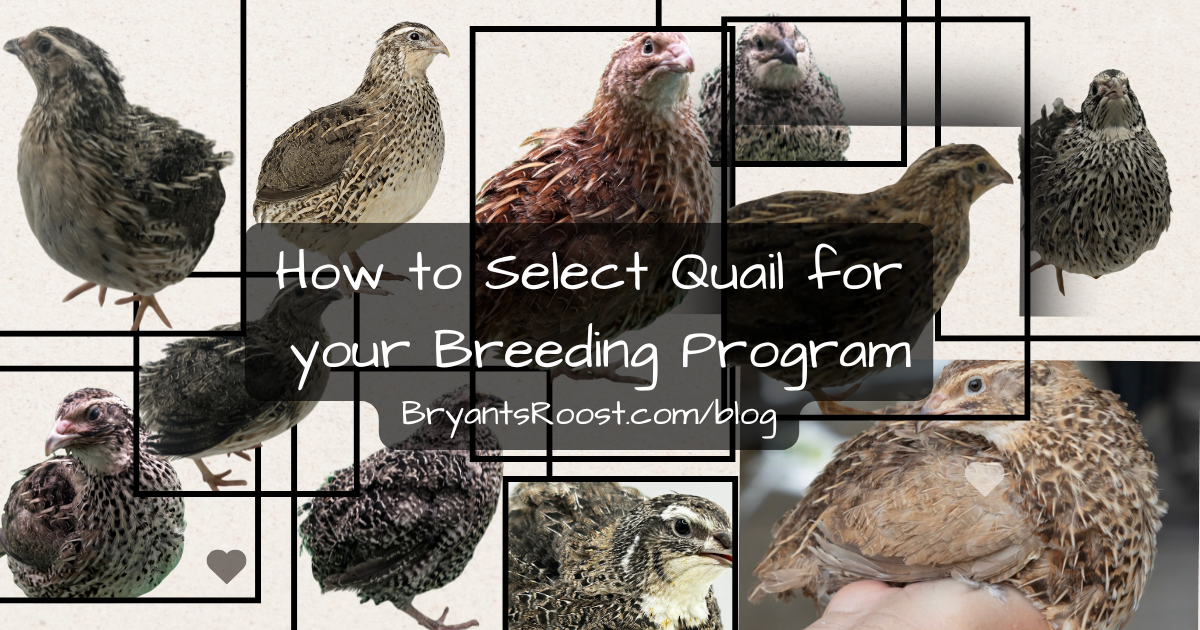
For more information, check out Jennifer’s blog on quail selection here.
As breeding programs mature, many breeders discover that family performance matters more than individual excellence. A single exceptional bird can influence a flock for a season. A consistently productive family line can influence it for decades. When evaluating potential breeders, it is often worth asking whether you would rather own one extraordinary bird or an entire family that reliably produces above-average offspring. Most experienced breeders eventually choose the family because predictability is one of the most valuable traits in animal breeding.
Ultimately, the goal of selection is not to create a single impressive generation. The goal is to build a flock that continues improving year after year. That requires patience, discipline, and a willingness to focus on long-term performance rather than short-term excitement.
Every breeding season presents hundreds of selection decisions. Individually they may seem small. Collectively they determine the future of the flock. That is why selection remains one of the most important skills any breeder can develop.
Listen to this week's Poultry Nerds Podcast episode as Carey Blackmon and Jennifer Bryant discuss practical strategies for evaluating breeding quail, setting breeding goals, and making selection decisions that improve flock performance over time.