Not All Eggs Are Created Equal: Egg Selection for Hatching
Most hatch failures are blamed on the incubator.
Temperature, humidity, or equipment failure are usually the first suspects.
But in practical breeding systems, hatchability is often determined before the egg ever enters the incubator.
Egg selection is not a minor variable. It is the starting point of the entire incubation process. If the egg is compromised at collection, no level of incubation precision will recover that loss.
This is the core concept discussed in this week’s episode of the Poultry Nerds Podcast.
Hatchability Begins Before Incubation
An egg is not an inert object. It is a biological system with:
A developing embryo (if fertilized)
A gas exchange system through the shell
A protective cuticle (bloom)
A moisture regulation system
Each of these components can be compromised before incubation begins.
Research across poultry incubation literature consistently shows that egg quality at set directly impacts:
Fertility expression
Embryo survival
Hatch timing
Chick vigor
(Meijerhof, 1992; Wilson, 1991; Deeming, 1995)
This means selection is not optional. It is foundational.
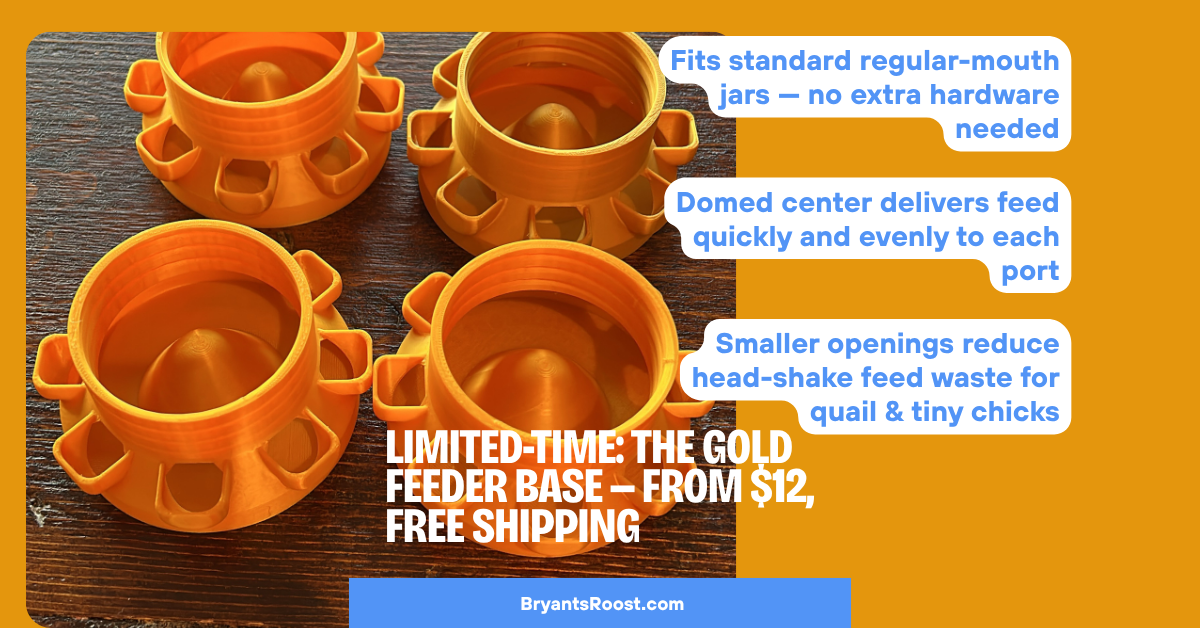
Proper feeder space plus no waste combined into one beautiful yet practical feeder.
Core Selection Criteria for Hatching Eggs
Egg Shape and Embryo Orientation
Egg shape directly influences internal structure and embryo positioning.
Abnormal eggs often result in:
Misaligned air cells
Improper embryo orientation
Increased risk of malposition at hatch
Eggs to exclude:
Elongated or torpedo-shaped eggs
Excessively round eggs
Severely pointed eggs
Even subtle deviations can affect hatch success in controlled systems.
Egg Size and Uniformity
Egg size is not just a cosmetic trait. It reflects:
Hen physiology
Nutritional status
Reproductive consistency
Selection guidelines:
Avoid oversized eggs (frequently double-yolked or structurally inconsistent)
Avoid undersized eggs (often linked to immature or stressed hens)
Prioritize uniform, breed-consistent size
Uniformity in egg size contributes to:
More consistent incubation timelines
Narrower hatch windows
Improved chick uniformity
Shell Quality and Structural Integrity
The shell is the embryo’s environment.
It regulates:
Water loss
Gas exchange (oxygen in, carbon dioxide out)
Microbial protection
Shell defects directly reduce hatchability.
Exclude eggs with:
Thin shells
Wrinkling or deformities
Excessive porosity
Cracks or repaired fractures
Compromised shells increase:
Moisture imbalance
Bacterial penetration
Embryo mortality
Cleanliness and the Cuticle (Bloom)
Clean eggs are not the same as washed eggs.
The outer layer of the egg, known as the cuticle or bloom, serves as a natural barrier against bacteria.
Washing removes or damages this layer, increasing the likelihood of contamination entering through shell pores.
Best practice:
Select eggs from clean nesting environments
Reject visibly contaminated eggs
Avoid washing hatching eggs whenever possible
Commercial hatchery systems may use controlled sanitation protocols, but these are not directly transferable to small-scale or shipped egg systems without risk.
Egg Age and Storage Effects
Egg viability declines over time.
Key factors:
Storage duration
Storage temperature
Handling frequency
Extended storage leads to:
Decreased hatchability
Increased early embryonic mortality
Reduced chick quality
Even under optimal conditions, older eggs perform worse than fresh eggs.
The Selection Problem in Backyard and Small-Scale Systems
A consistent pattern appears in small-scale incubation:
Eggs are selected based on availability rather than quality.
Common behaviors include:
Incubating all collected eggs without culling
Justifying poor-quality eggs due to cost or scarcity
Assuming incubation conditions can compensate for poor inputs
This introduces uncontrolled variables into the hatch.
The result is inconsistent outcomes that are incorrectly attributed to incubation technique.
Selection Discipline as a Breeder Skill
In controlled breeding systems, selection occurs before incubation.
This includes:
Culling substandard eggs
Maintaining consistency across sets
Tracking hatch outcomes relative to selection criteria
This process reduces variability and increases predictability.
The difference between inconsistent hatch results and repeatable performance is often selection discipline.
Increased Importance in Shipped Eggs
Eggs that are shipped are already exposed to additional stressors:
Mechanical vibration during transport
Temperature fluctuations
Orientation disruption
Handling impacts
These stressors can affect:
Air cell stability
Internal membrane integrity
Embryo viability
When poor egg selection is combined with shipping stress, hatch outcomes decline significantly.
Selection becomes more critical, not less.
Practical Application
To improve hatch outcomes:
Set fewer eggs, but increase selection standards
Eliminate eggs with any structural or visual defects
Prioritize uniformity in size and shape
Source eggs from clean, well-managed breeding environments
Reduce reliance on marginal eggs
Each egg placed into the incubator should meet defined criteria.
Frequently Asked Questions
Does egg shape really affect hatchability?
Yes. Egg shape influences internal structure and embryo positioning, which can affect successful hatch orientation.
Can slightly dirty eggs be incubated?
They can, but they carry increased bacterial risk and should be excluded in controlled hatching systems.
Do larger eggs produce better chicks?
Not necessarily. Oversized eggs often indicate abnormalities such as double yolks or inconsistent internal structure.
Is egg selection more important than incubation settings?
Both are critical, but poor egg quality cannot be corrected by ideal incubation conditions.
Conclusion
Hatchability does not begin with temperature or humidity.
It begins with selection.
Every egg placed into an incubator represents a decision. Consistent hatch outcomes depend on consistent selection criteria applied before incubation begins.
For breeders focused on improving results, egg selection is the first variable to control.